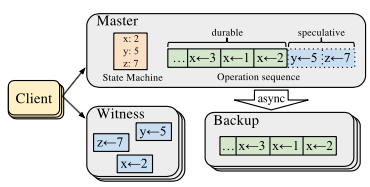
Traditional approaches to replication require client requests to be ordered before making them
durable by copying them to replicas. As a result, clients must wait for two round-trip times (RTTs)
before updates complete. On the other hand, Consistent Unordered Replication Protocol (CURP) allows
clients to replicate requests that have not yet been ordered, as long as they are commutative. This
strategy allows most operations to complete in 1 RTT (the same as an unreplicated system).
I implemented CURP in the Redis and RAMCloud storage systems. In RAMCloud, CURP improved write
latency by ~2x and write throughput by 4x.
ARGUS: CURP on SmartNICs
ARGUS moved CURP’s temporary backup servers from user-level processes to SmartNICs. This approach
brings about two benefits: better tail latency and saving of CPU resources. Using Linux processes
for backup servers results in high tail latency due to various software overheads (e.g., networking
stack and context switching overhead). Using more backups makes the problem even worse since
clients must wait for replication to complete at all backup servers. This undesirable effect is
known to be especially problematic in public clouds. ARGUS avoids this issue by taking advantage of
SmartNICs’ proximity to the wire, minimal software overhead, and line-rate throughput.